

How Water Tank Fire Trucks Work and How to Choose One | Jiangte
How Water Tank Fire Trucks Work and How to Choose One
Water tank fire trucks are among the most fundamental and widely used apparatus in any fire service fleet. This article explains their working principle and offers practical guidance for procurement decision-makers in government and enterprise fire safety.
1. What Is a Water Tank Fire Truck
A water tank fire truck carries firefighting water in an onboard tank and is equipped with a fire pump and monitor (or hose lines) to attack fires independently or in coordination with other units. It is suited to initial attack in urban, roadside and industrial settings, and serves as the primary apparatus for long-distance water supply in areas with limited hydrants.
Note: A water tank fire truck belongs to the fire apparatus category. It should not be confused with water sprinkler trucks used for road cleaning or landscaping, which differ in function, standards and application.
2. Core Components and Working Principle
-
Water tank: Stores water at atmospheric pressure, usually built from carbon steel or stainless steel with baffles to reduce sloshing.
-
Fire pump: Driven by the chassis engine through a power take-off (PTO), it pressurizes water for delivery—the power core of the system.
-
Monitor / hose lines: Direct high-pressure water flow to the fire; monitors reach farther, hose lines offer flexibility.
-
Piping and valves: Connect tank, pump and monitor to switch between drafting, filling and discharge.
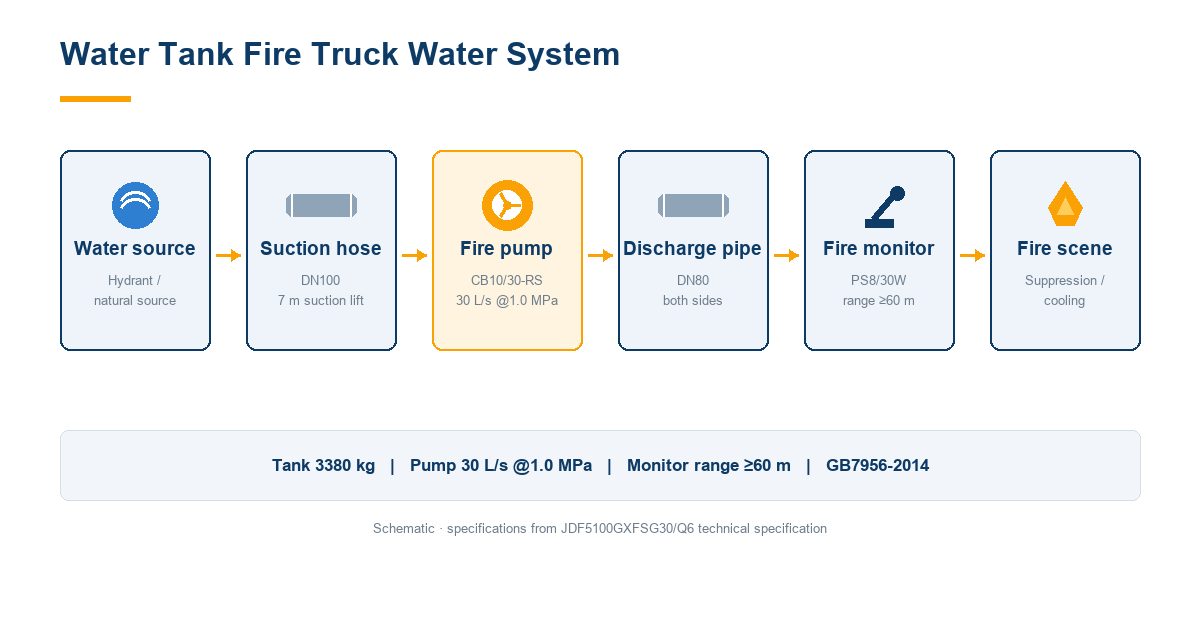
Workflow: Draw water from a hydrant or natural source → fire pump pressurizes it → water is delivered through piping to the monitor / hose lines for extinguishment.
3. How to Choose (Procurement Checklist)
| Aspect | What to Look At |
|---|---|
| Tank capacity & response radius | Match tonnage to district size and water source layout. Jiangte water tank fire trucks are announced across a 3 t to 25 t range to fit different fire-service tiers |
| Chassis & mobility | Choose a China VI-emission mainstream chassis (Qingling, Dongfeng, Sinotruk, etc.); select drive configuration by urban or rough-terrain use |
| Pump performance | Check rated flow and outlet pressure to match monitor range and suppression demand |
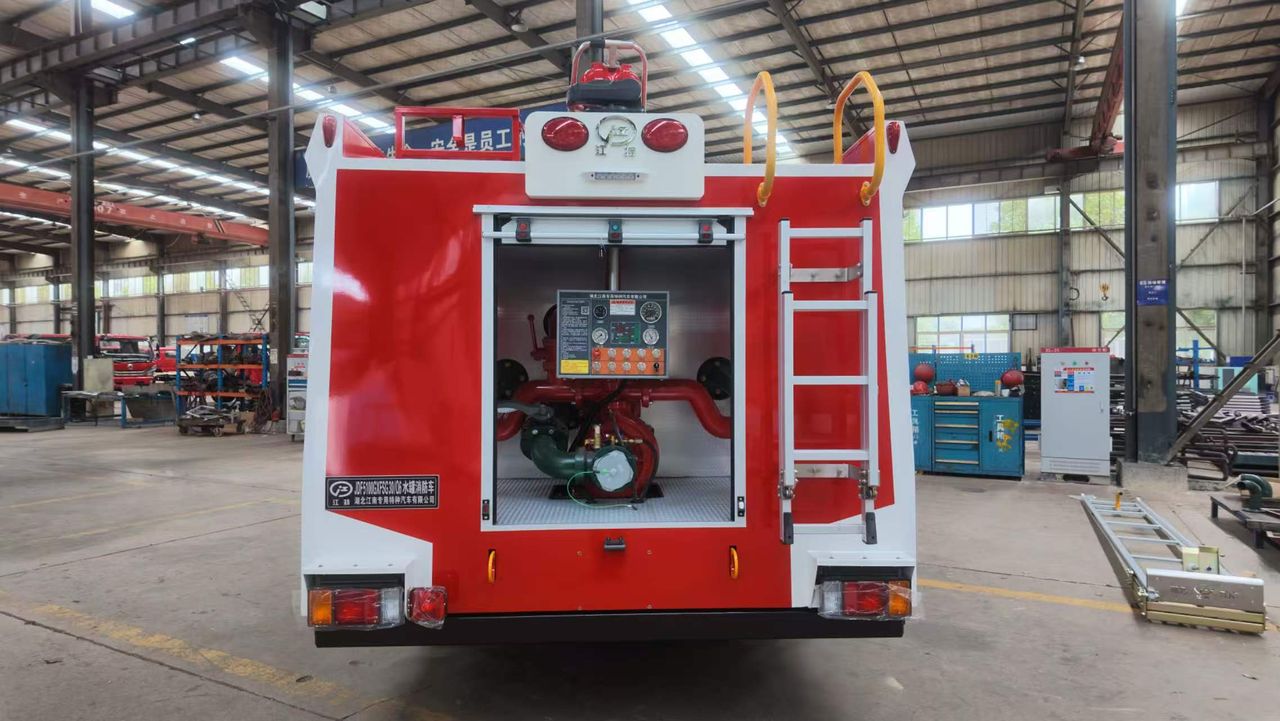
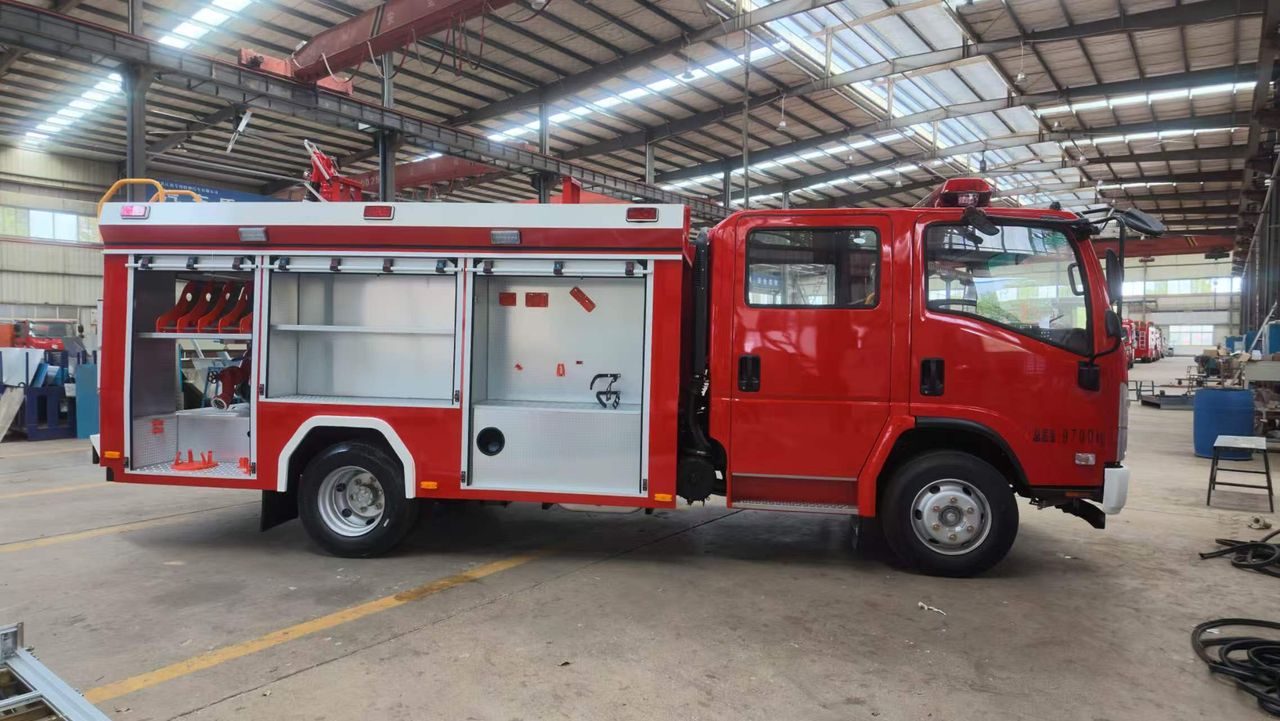
| Body configuration | Compartment and pump-room layout affect response speed and equipment access |
| Scenario fit | Industrial parks and towns impose different demands on mobility and capacity |
4. Jiangte Model Example: JDF5100GXFSG30/Q6 Water Tank Fire Truck
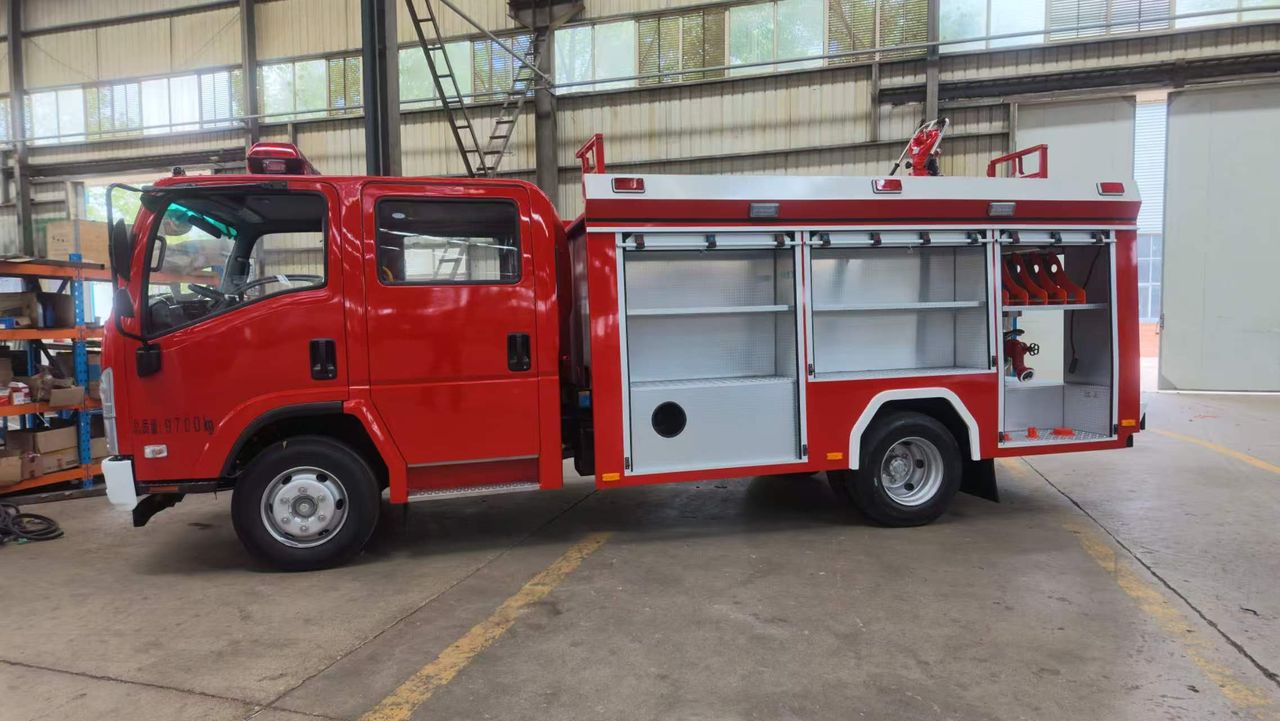
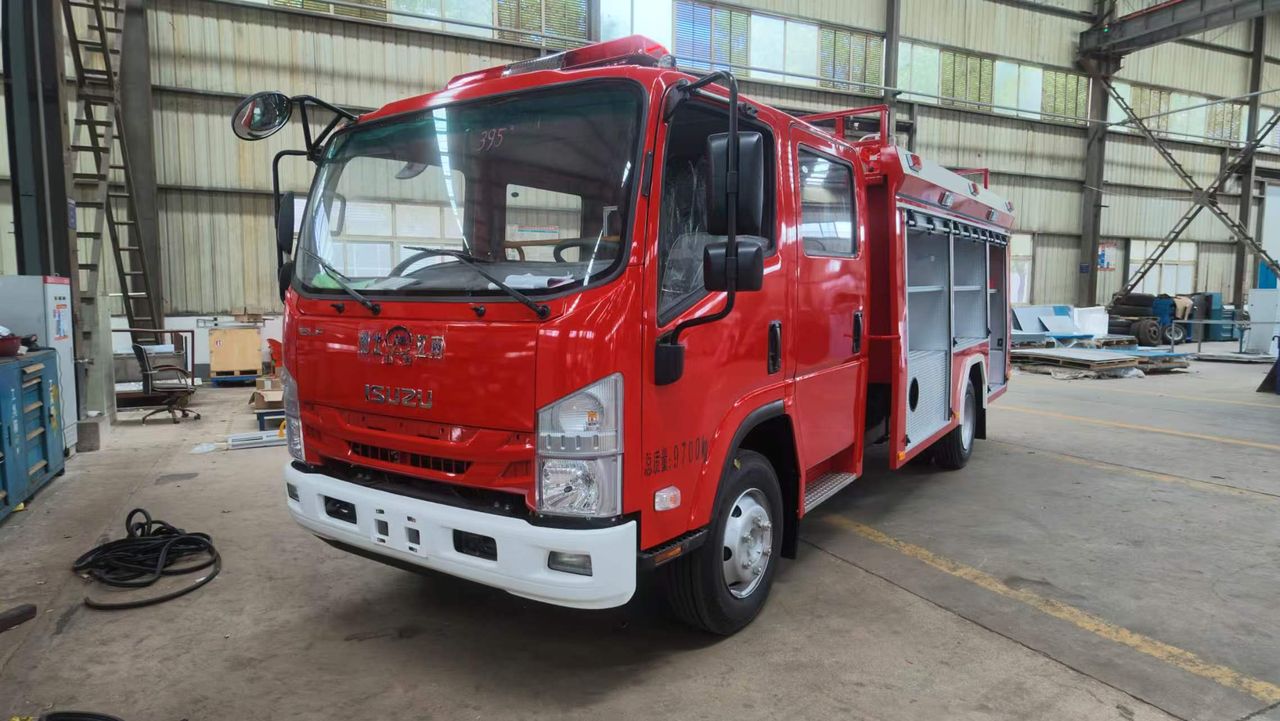
The JDF5100GXFSG30/Q6 water tank fire truck is built on a Qingling QL1110ANKAY chassis with an inner-tank body layout—equipment compartments on both sides, the water tank in the middle and the pump room at the rear. The double-row crew cab seats 3+3. Compact and highly mobile, it suits initial attack at enterprises, communities and key fire-risk units, and is widely used by fire rescue stations, government professional fire brigades and enterprise fire brigades.
| Item | Specification |
|---|---|
| Chassis model | Qingling QL1110ANKAY (4×2, wheelbase 3815 mm) |
| Engine power / displacement | 139 kW / 5193 ml |
| Emission standard | China VI (GB17691-2018) |
| Overall dimensions | 6860 × 2290 × 3050 mm |
| Gross vehicle mass | 9700 kg |
| Water tank capacity | 3380 kg |
| Fire pump | CB10/30-RS low-pressure fire pump, rated flow 30 L/s @1.0 MPa, max suction depth 7 m |
| Fire monitor | PS8/30W vehicle monitor, flow 30 L/s, range ≥60 m, 360° horizontal rotation |
| Crew | 3+3 |
| Maximum speed | 95 km/h |
| Tank material | Quality carbon steel, 3 mm |
| Standards | Fire performance complies with GB7956-2014; inspected by the national fire equipment quality supervision and test centre, CCCF filed |
| Body colour | R03 fire red |
5. Operation and Maintenance Tips
-
Regularly inspect the fire pump, piping seals and valve operation;
-
Maintain tank corrosion protection and periodic cleaning;
-
After operation in cold weather, drain residual water from piping to prevent freezing damage.
Technical principles in this article are general fire-apparatus knowledge; JDF5100GXFSG30/Q6 specifications are taken from the model's technical specification sheet and are subject to China's official Vehicle Announcement. Model-specific parameters should be verified against the official model announcement before use.