

Fire Truck Export Guide: Chassis, Climate & Shipping Options
Exporting a fire truck is never one-size-fits-all. Because road conditions, climate, emission standards and registration rules vary by market, the same model often needs different chassis, drive layout and shipping arrangements overseas. This guide covers eight key configuration choices — chassis, climate adaptation, firefighting system and RORO/container shipping — to confirm before you order.
1. Why export configuration is different
A fire truck that works well in one country may be unsuitable in another. Road conditions, terrain, ambient temperature, fuel quality and local vehicle regulations all affect how an apparatus should be built. For overseas buyers, clarifying these conditions before placing an order helps avoid costly modifications after delivery.
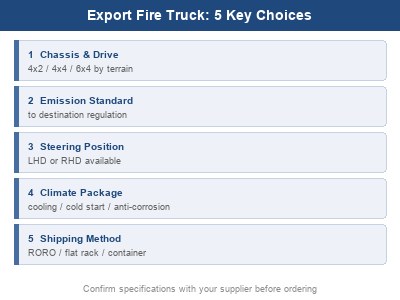
Five configuration choices to confirm before ordering an export fire truck
2. Chassis and drive configuration
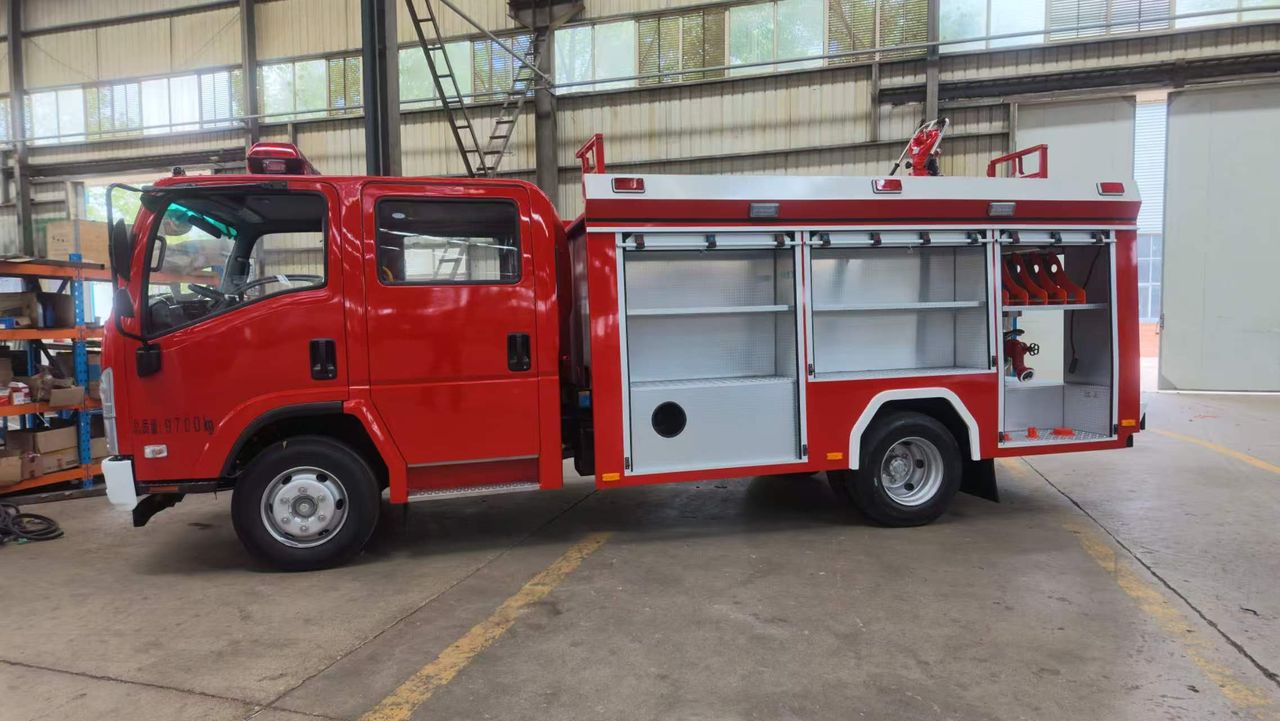
The chassis determines payload capacity, off-road capability and long-term service support. Common options include 4x2 for urban paved-road duty, 4x4 for rural, forest and mining access, and 6x4 or heavier configurations for large water and foam tankers. Buyers should match the drive type to the actual road surface and gradient of their service area rather than simply choosing the largest available unit.
3. Emission standard, steering and local registration
Emission requirements and vehicle registration rules differ by destination, and they directly affect whether a vehicle can be licensed for road use. Buyers should confirm the applicable emission level and whether left-hand drive (LHD) or right-hand drive (RHD) is required in their market. These items must be settled at the quotation stage, as they are determined by the chassis and cannot easily be changed after production.
4. Adapting to climate and working conditions
Operating environment has a direct impact on reliability. In high-temperature regions, cooling capacity, water tank insulation and pump heat dissipation deserve attention. In cold regions, low-temperature starting, antifreeze protection for the pump and pipework, and winter-grade hydraulic oil should be specified. For coastal or high-salinity environments, anti-corrosion treatment of the body frame, tank and fasteners helps extend service life. High-altitude operation additionally requires checking engine power compensation.
5. Firefighting system and tank options
Configuration depends on the risk profile of the response area. Water tankers suit general structural fires; foam proportioning systems are specified where flammable liquid risks exist; dry powder units are used for certain industrial and gas-related incidents. Tank material is another selection point, commonly carbon steel, stainless steel or engineered plastic, each balancing weight, corrosion resistance and service life. Pump drive is typically taken from the chassis PTO, and the rated flow should be matched to the hose layout and monitor actually used in the field.
6. Shipping methods: RORO, flat rack and container
Complete vehicles are most commonly shipped by RORO (roll-on/roll-off) vessels, which allow the truck to be driven on and off and generally suit fully built units. Where a route or port does not support RORO, flat rack or break bulk shipment is an alternative, with the vehicle secured and protected against weather and salt spray. Compact units may be containerised after partial dismantling, which reduces freight cost but requires reassembly and commissioning at destination. The choice affects both freight cost and the amount of preparation work on arrival, so it should be agreed before shipment.
7. Documentation, training and spare parts
Beyond the vehicle itself, buyers should confirm the document package accompanying the shipment, typically including the commercial invoice, packing list, certificate of origin and export documentation required by the destination. Operation and maintenance manuals, basic operator training, and a recommended spare parts list for the first period of service are worth agreeing in advance, as they shorten the time from delivery to full operational readiness.
8. Jiangte's approach
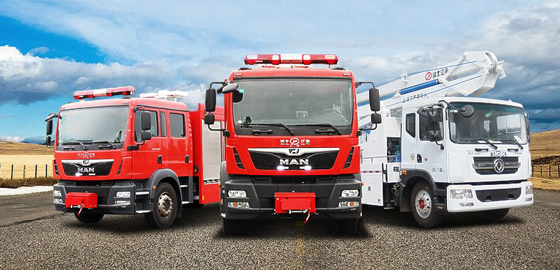
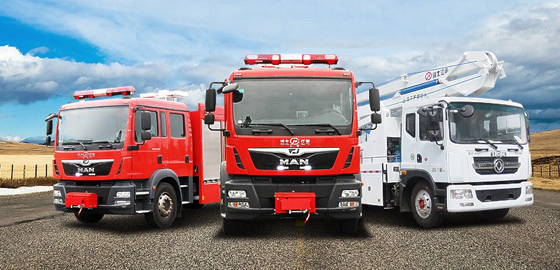
Jiangte (JDF) builds fire and emergency vehicles on a range of chassis platforms covering water, foam, aerial and specialised rescue applications, including drainage rescue, emergency power supply and field support units. Configuration is discussed against the buyer's operating conditions, local regulations and intended response scenarios. Buyers are welcome to share their service environment and requirement list so that a matching specification can be worked out before quotation.
For overseas buyers, the most practical first step is to prepare a short requirement list: response scenario, water or foam capacity, drive type, steering position, applicable emission level and destination port. With these six items clarified, specification and quotation can proceed much faster.