
Technical Analysis | JDF5071GXFSG20/Q6 Water Tank Fire Truck: How a 7-Ton Platform Matches Grassroot
Hubei Jiangnan Special Automobile Co., Ltd. has recently launched "5-Minute Fire Squad", an equipment knowledge column aimed at grassroots fire and rescue teams as well as government and enterprise buyers, explaining the selection logic and technical essentials of firefighting special vehicles in plain language. The first article focuses on the company's Jiangte JDF5071GXFSG20/Q6 water tank fire truck, covering vehicle structure, water system configuration and announcement compliance, and explaining the model's technical features and suitable applications item by item.
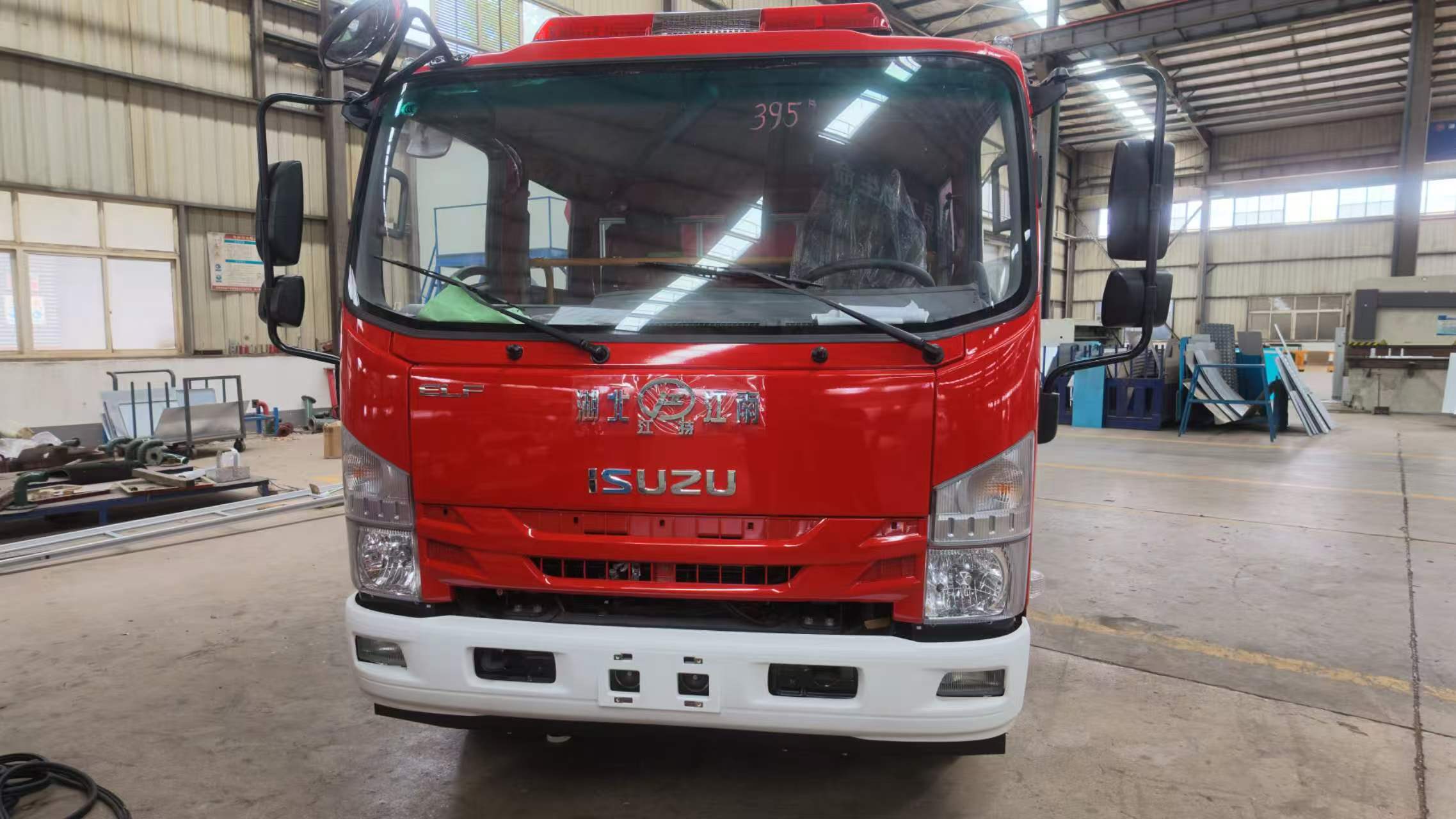
The vehicle is converted from a Qingling QL1070BUHWY chassis. The complete vehicle meets the requirements of GB7956-2014; the chassis holds China Compulsory Certification; engine emissions comply with the Stage 6 limits of GB17691-2018; and the vehicle has passed testing by the National Fire Equipment Quality Supervision and Inspection Center and is listed in the MIIT announcement of new automotive products.
I. Selection Step One: Define the Scenario, Then the Category
Fire and rescue equipment can be divided by application into water tank fire trucks, foam fire trucks, water tower fire trucks, rescue fire trucks, and functional vehicles such as emergency rescue and drainage vehicles. Among them, the water tank fire truck uses water as the extinguishing agent and is suited to Class A fires (solid materials). It is standard equipment for township government professional fire brigades, enterprise professional fire brigades and key fire-safety units.
The company's technical team advises that buyers should first define the protected object and the fire type, then determine the vehicle category, and only then compare specific specifications — reversing this order often results in a configuration that does not match actual needs.
II. Main Vehicle Specifications
| Item | Specification |
| Overall dimensions | 6390×1960×2950 mm |
| Gross vehicle weight | 6,810 kg |
| Liquid payload | 2,035 kg water |
| Maximum speed | 95 km/h |
| Rated pump flow | 30 L/s @ 1.0 MPa |
| Monitor range | ≥ 60 m |
| Approach / departure angle | 24° / 13° |
| Drive type | 4×2 |
| Wheelbase | 3,360 mm |
| Minimum turning radius | ≤ 7 m |
It should be noted that with a gross vehicle weight of 6,810 kg the vehicle falls into the yellow-plate category in China and requires a driver holding a Class B licence or above. With an overall length of 6.39 m and a minimum turning radius within 7 m, it can cope with the access conditions of township roads, factory passages and residential branch roads.
III. Technical Features
1. Chassis Configuration
The vehicle uses a Qingling QL1070BUHWY chassis with an engine displacement of 2,999 ml and a rated power of 88 kW, 4×2 drive, a wheelbase of 3,360 mm, a manual gearbox and a YTQ200 power take-off. The power-to-weight ratio is 88/6.81 ≈ 12.92 kW/t, balancing performance with ease of daily maintenance — suited to the high-frequency duty cycles of grassroots teams.
2. Bodywork Structure
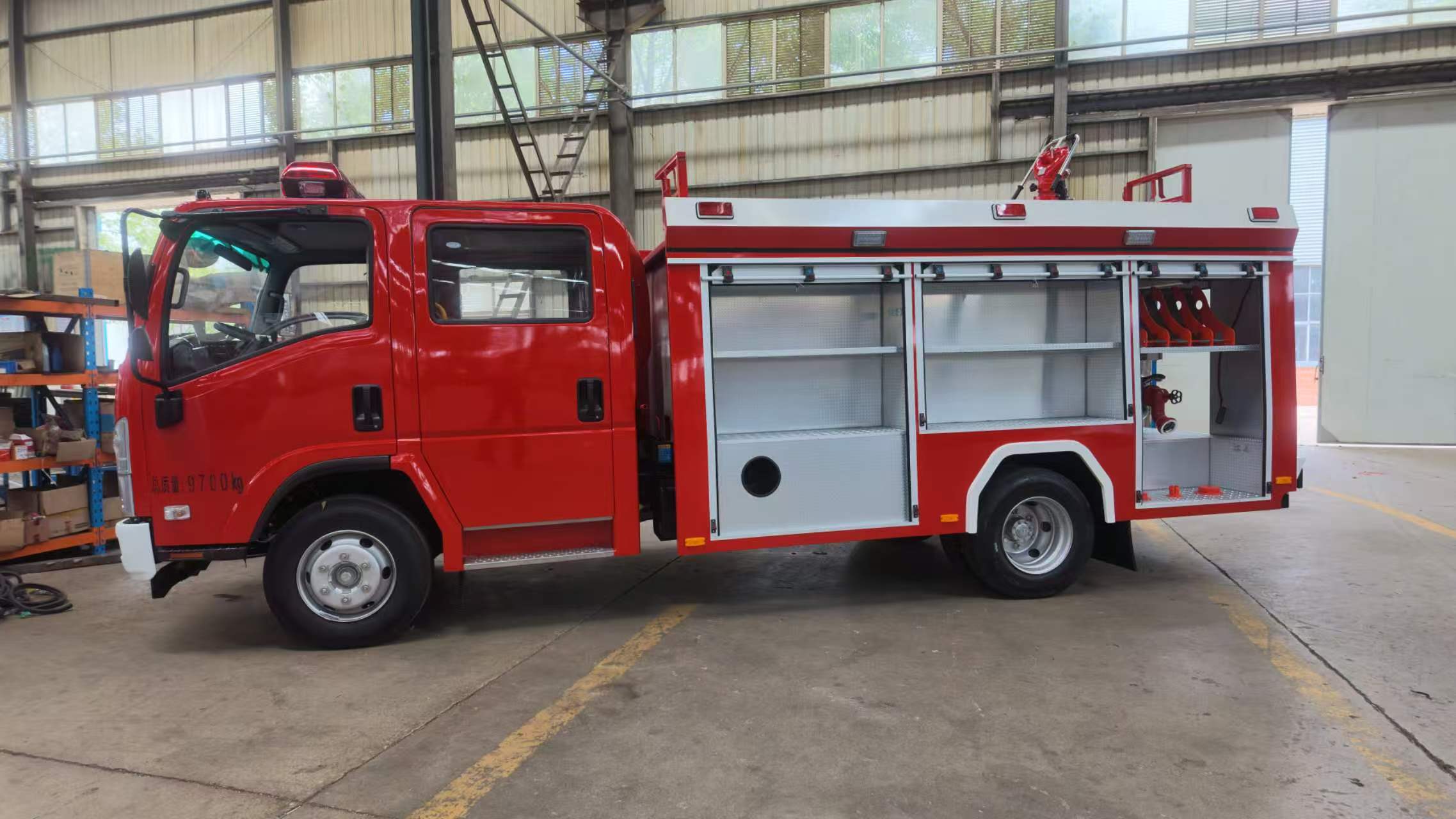
The body adopts an internal-tank structure: equipment compartments on both the left and right sides, the water tank in the middle, and the pump room behind the equipment compartments. The equipment compartments are fitted with aluminium alloy roller shutter doors and interior lighting, with equipment arranged in the sequence of firefighting operations and secured by dedicated brackets, making it easy for several crew members to access equipment simultaneously. The pump room is located at the rear of the vehicle, with aluminium alloy roller shutter doors on both sides and at the rear.
The liquid tank is made of high-quality carbon steel, 3 mm thick, with internal transverse anti-surge baffles and angle-iron reinforcement on the top plate. It can withstand 0.1 MPa hydrostatic pressure and has passed hydrostatic strength testing; the tank is bolted to the chassis and the whole assembly is treated against corrosion. The tank is fitted with a 460 mm diameter manhole (with quick-locking/opening device), a DN65 overflow port, a DN40 residual water drain and one DN65 filling inlet on each side.
3. Water System and Firefighting Equipment
The vehicle is equipped with a CB10/30-XZ low-pressure vehicle fire pump (low-pressure centrifugal type), with a rated flow of 30 L/s @ 1.0 MPa and a maximum suction depth of 7 m. Fitted with a piston-type vacuum pump, the priming time at maximum suction depth does not exceed 50 seconds. The piping system uses high-quality seamless steel pipes: a DN100 suction inlet at the rear of the pump room and one DN80 outlet on each side of the pump room (with stop valve and blind cap).
A PS8/30W vehicle fire monitor is mounted on the roof, with a flow rate of 30 L/s and a range of not less than 60 m, horizontal rotation of 360°, a depression angle not exceeding −15° and an elevation angle not less than +60°, allowing the fire to be suppressed from a safe distance.
4. Control and Electrical System
The vehicle has two control panels — one in the cab and one in the pump room — integrating the pump tachometer, tank level gauge, vacuum pressure gauge, outlet pressure gauge and function keys. Functions include emergency stop, main power, equipment lighting, pump room lighting, side lighting, rear lighting and priming, with a remote electronic throttle. The wiring uses 12-channel relay and fuse dual-layer protection, with a 10 A blade fuse on each output circuit. Red strobe lights are installed on both sides of the body, a full-red long-row warning light bar on the cab roof and a 100 W fire searchlight at the rear of the bodywork. An aluminium alloy two-section folding ladder is fitted at the rear, positioned no more than 450 mm above the ground when deployed.
IV. Applications
Configuration and upgrading of township government professional fire brigades and village-level micro fire stations
Enterprise professional fire brigades (factory sites, warehouses, logistics parks)
Initial-stage firefighting and evacuation at key fire-safety units
Small and medium-sized stations where a single vehicle must provide initial-stage firefighting capability
For petrochemical and fuel storage and transport scenarios where foam extinguishing is the main requirement, and for urban stations whose primary mission is high-rise buildings, the company recommends the corresponding models — foam fire trucks and water tower fire trucks respectively.
V. Service and Enquiries
Based on the user's protected objects, road conditions and actual crew situation, the company can provide technical services including model selection advice, verification of announcement parameters and configuration proposals. To learn more about the detailed configuration of the JDF5071GXFSG20/Q6 water tank fire truck, please contact us via the website message form or online enquiry, and we will arrange for a technical specialist to follow up.