
5-Minute Fire Squad | Why a 7-Ton Water Tank Fire Truck Is the Baseline Choice for Township and Ente
Opening: The Most Common Question from the Grassroots Level
Having worked in firefighting equipment for years, the question I hear most often is: "We're just a small town (or a factory) — what kind of fire truck gives us enough capability without wasting money?"
Behind this question lie three specific concerns: can the vehicle get in, is the water enough for the initial-stage fire, and who in the crew can drive it. Today, taking a 7-ton water tank fire truck — Jiangte JDF5071GXFSG20/Q6 — I'll unpack this selection logic. It takes about five minutes to read, and afterwards, when you compare specifications with manufacturers or suppliers, you won't be easily led astray.
I. First, Clarify a Concept: A Fire Truck Is Not "One Type of Vehicle"
Many procurement documents simply state "purchase of fire trucks". Professionally, this does not hold up — choose the wrong category and problems will arise in acceptance and daily use. The common categories:
Water tank fire truck: uses water as the extinguishing agent, mainly for Class A fires (solid materials) — the baseline configuration for grassroots fire stations
Foam fire truck: water plus foam concentrate, covering both Class A and B fires (solids and liquids); required for petrochemical and fuel storage sites
Water tower fire truck (elevated spraying): fitted with a boom for high-level discharge, for high-rise buildings and large tank farms
Rescue fire truck: breaking, lighting and rescue equipment integrated in one vehicle, for traffic accidents, earthquakes and similar scenarios
Emergency rescue / drainage vehicle: functional vehicles for emergency drainage, power generation, lighting and high-flow drainage
One-line principle: define the scenario first, then the category, and only then compare specifications. Reverse that order and you will almost certainly buy the wrong vehicle.
II. Why the "7-Ton Class" Is an Important Divide
First, registration and driving licence. In China, vehicles with a gross weight below 4.5 t are registered with a blue plate and can be driven with a Class C licence; 4.5 t and above require a yellow plate and a Class B licence or above. This JDF5071GXFSG20/Q6 has a maximum gross weight of 6,810 kg, which falls within the yellow-plate range — before purchasing, confirm whether your team has a driver holding a Class B licence or above. This is the most practical implementation issue.
Second, road conditions. Overall dimensions are 6390×1960×2950 mm with a minimum turning radius of ≤7 m. This footprint can enter most township roads, factory access roads and residential branch roads, and moves through villages and narrow lanes without difficulty. Add more tonnage or length, and many old-town blocks simply become inaccessible.
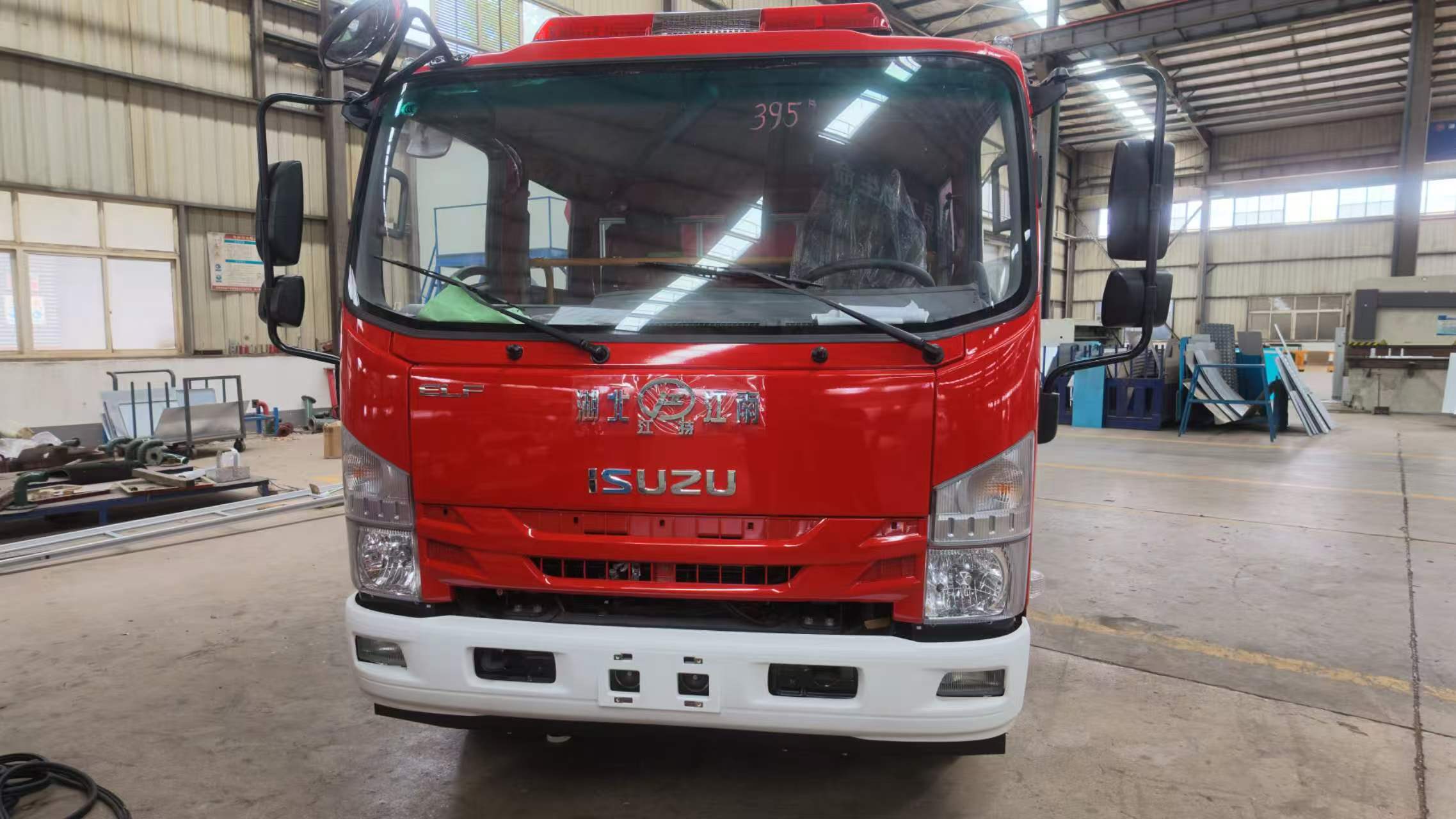
Conclusion: the 7-ton class is not "small" — it is "just right", striking a balance between mobility, liquid payload and purchase economics.
III. Taking the Vehicle Apart: What a Typical Compact Water Tank Truck Looks Like
1. Chassis: Determines How Well It Drives and How Easily It Is Serviced
The vehicle is built on a Qingling QL1070BUHWY chassis, with an engine displacement of 2,999 ml and a rated power of 88 kW. Emissions meet the Stage 6 limits of GB17691-2018 (China VI). Drive type is 4×2, wheelbase 3,360 mm, manual gearbox, fitted with a YTQ200 power take-off.
For grassroots teams, the value of this combination lies in being mature, easy to maintain and easy to source parts for, with controllable fuel consumption and servicing costs in daily duty. The vehicle's power-to-weight ratio is 88/6.81 ≈ 12.92 kW/t, approach and departure angles are 24°/13°, and maximum speed is 95 km/h — fully adequate mobility for everyday emergency response.
2. Bodywork: The Internal-Tank Structure, and What Sets It Apart from an "Exposed Tank"
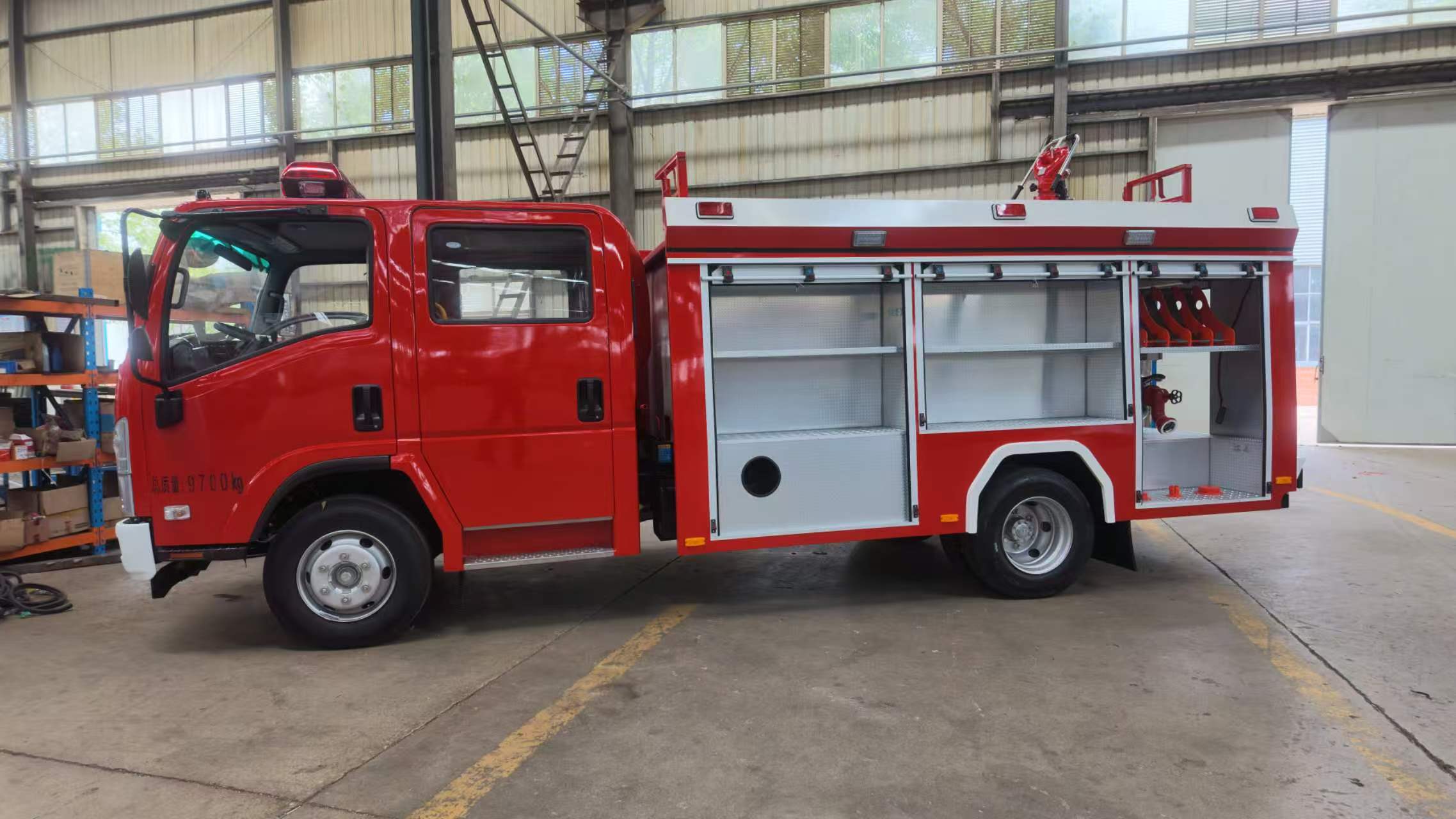
This vehicle adopts an internal-tank structure — equipment compartments on both sides of the body, the water tank in the middle, and the pump room at the rear of the equipment compartments.
What contrasts with the internal tank is the "exposed tank body" widely used on low-cost converted vehicles. The advantages of the internal tank are practical: independent equipment compartments with aluminium alloy roller shutter doors and interior lighting, equipment arranged by firefighting operating sequence and secured with dedicated brackets, so that several crew members can take out and stow equipment simultaneously without interfering with each other. On the fireground, those few dozen seconds are exactly what matters.
The tank itself: 3 mm high-quality carbon steel, with internal transverse anti-surge baffles and angle-iron reinforcement on the top plate, capable of withstanding 0.1 MPa hydrostatic pressure and having passed strength testing; the tank is bolted to the chassis. These are the details you cannot see but that determine service life.
3. Water System: The Specification Says Only "30 L/s", but the Details Are Here
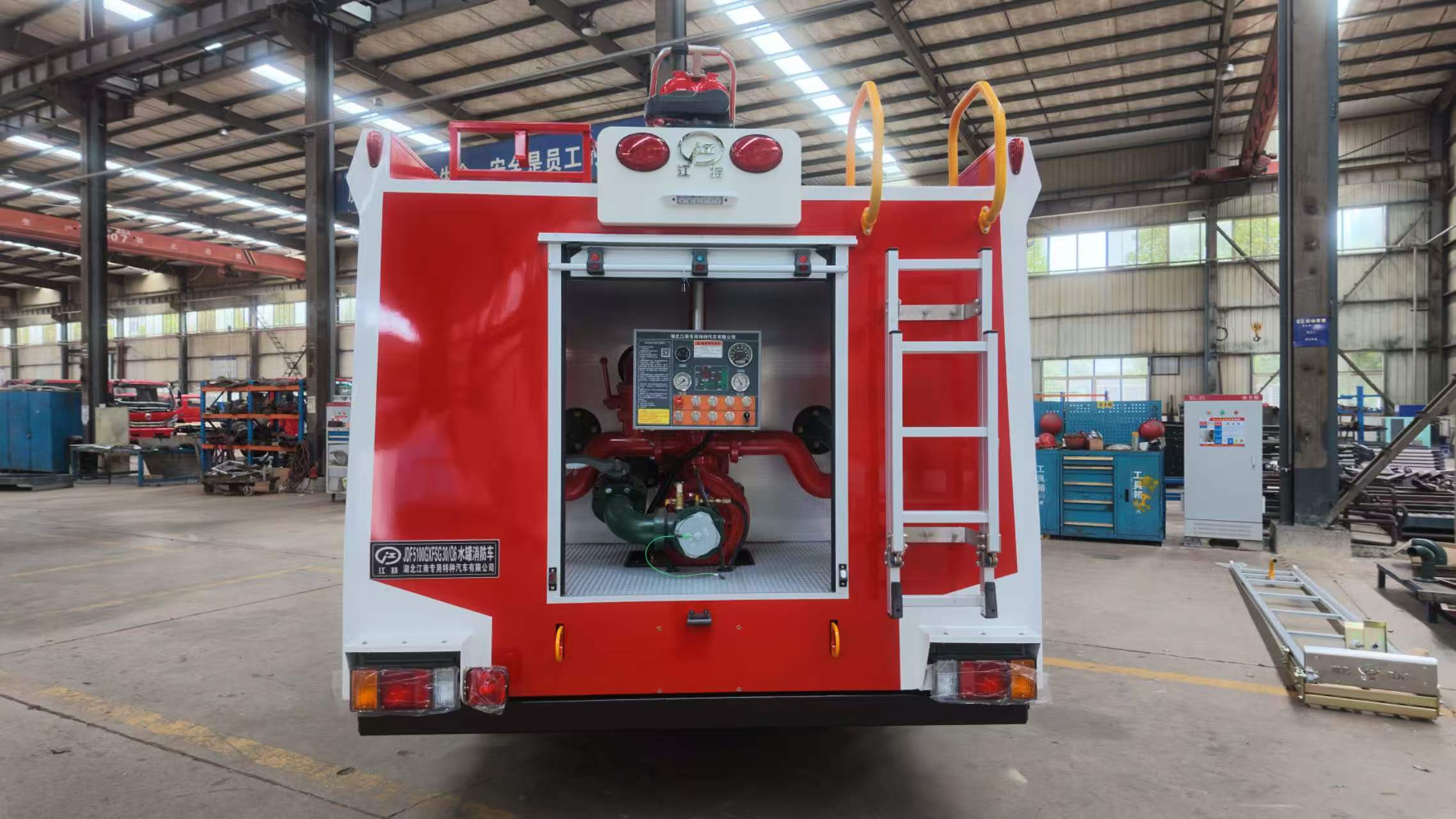
Fire pump: CB10/30-XZ low-pressure vehicle fire pump, low-pressure centrifugal type, rated flow 30 L/s @ 1.0 MPa
Maximum suction depth 7 m, priming time ≤ 50 s (with piston-type vacuum pump)
Piping: DN100 suction inlet at the rear of the pump room; one DN65 filling inlet on each side of the tank; one DN80 outlet on each side of the pump room, fitted with stop valve and blind cap
Tank fittings: one 460 mm manhole, DN65 overflow port, DN40 residual water drain, DN100 tank-to-pump inlet pipe, DN65 pump-to-tank filling pipe
What buyers should watch most closely is actually the "priming time". Two vehicles both rated at 30 L/s can differ by more than ten seconds from stopping to discharging, depending on the vacuum pump configuration. In the initial stage of a fire, those ten-odd seconds can decide the outcome. ≤ 50 s is this vehicle's published figure — use it as the benchmark when comparing specifications.
4. Firefighting Monitor: The Gun on the Roof
A PS8/30W vehicle fire monitor is mounted on the roof, with a flow rate of 30 L/s and a range of ≥ 60 m. Horizontal rotation is 360°, depression angle ≤ −15° and elevation angle ≥ +60°.
What does a 60 m range mean? Put simply, personnel can suppress the fire from a relatively safe distance — particularly suited to fire scenes that cannot be approached, such as factory stacking yards and warehouses.
5. Electrical System and Details
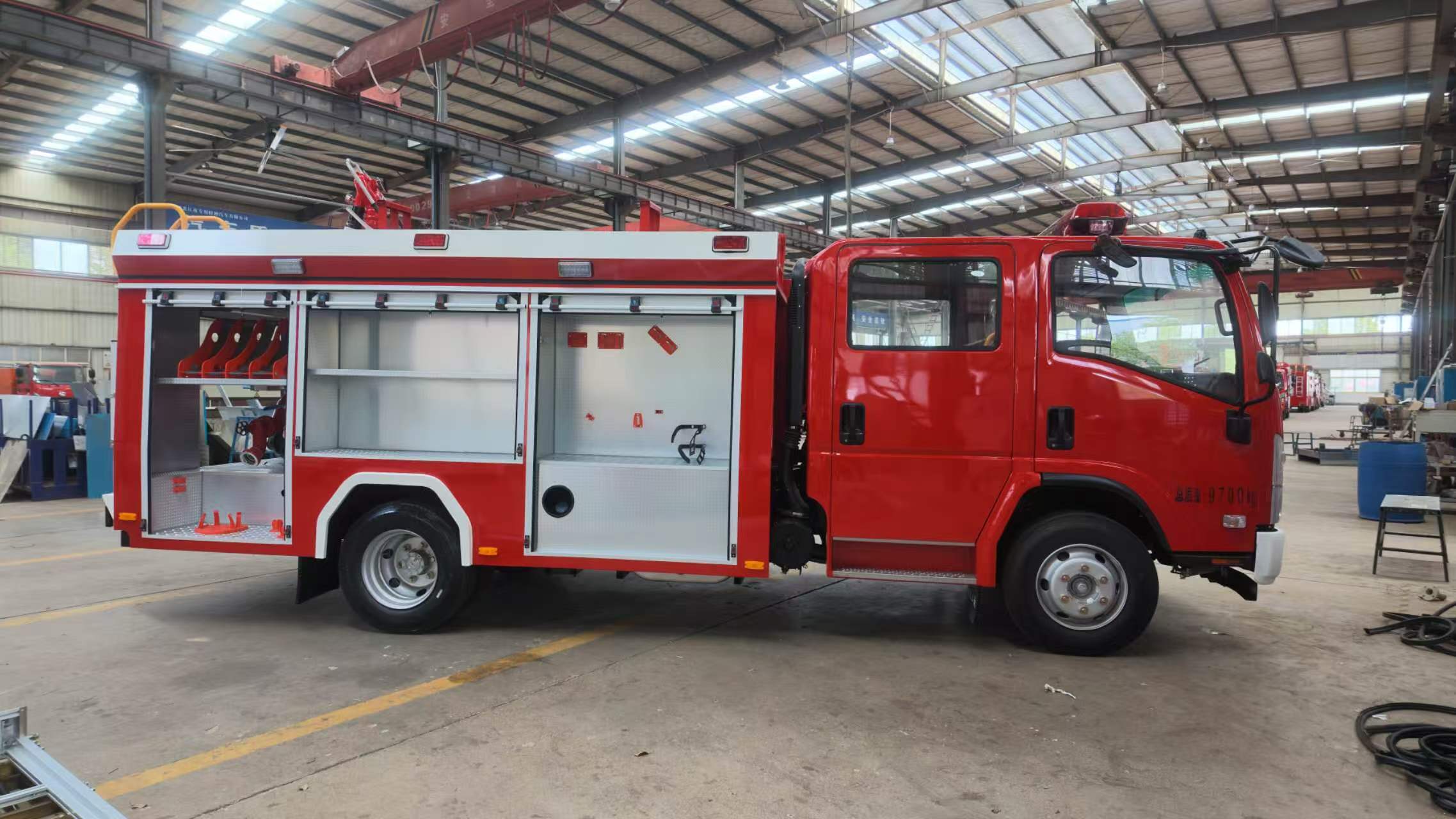
Full-red long-row warning light bar, red strobe lights on both sides of the body, and a 100 W fire searchlight at the rear of the bodywork. The pump room control panel integrates the pump tachometer, tank level gauge, vacuum pressure gauge and outlet pressure gauge, with function keys clearly grouped — emergency stop, main power, lighting and priming all within easy reach — and a remote electronic throttle. The wiring uses 12-channel relay plus fuse dual-layer protection, each channel fitted with a 10 A blade fuse that can be replaced on the spot. The rear ladder is an aluminium alloy two-section folding type, positioned no more than 450 mm above the ground when deployed.
These details may sound trivial, but they are exactly the things you only find out about after two years of use.
IV. Who This Vehicle Suits
Well suited to:
Township government professional fire brigades and upgrading village-level micro fire stations
Enterprise professional fire brigades (factory sites, warehouses, logistics parks)
Initial-stage fire response and evacuation at key fire-safety units
Small and medium-sized stations that need one vehicle to carry initial-stage firefighting capability
Less suited to:
Petrochemical and fuel storage and transport sites requiring large volumes of foam (a foam fire truck should be selected)
Urban stations whose primary mission is high-rise buildings (water tower / aerial equipment should be considered)
Scenarios requiring high-flow, long-distance water supply (larger tonnage or a water supply group is needed)
V. Five Practical Tips for Procurement Staff
Confirm driving licences first: yellow-plate vehicles (gross weight ≥ 4.5 t) require a driver holding a Class B licence or above — don't wait until the vehicle arrives to find out nobody can drive it.
Measure the roads on site: measure the narrowest road in town and the narrowest passage in the factory, then check the vehicle's length, width and turning radius.
Ask about priming time: don't compare flow rate alone — ask about maximum suction depth and priming time.
Look at tank construction: whether anti-surge baffles are fitted, whether a hydrostatic test report is available, and whether the tank is bolted or welded to the chassis.
Check the announcement and testing: the complete vehicle must meet GB7956-2014, pass testing by the National Fire Equipment Quality Supervision and Inspection Center and be listed in the MIIT announcement catalogue — missing any one of these will block registration and acceptance later.
Closing
There is no such thing as "the more highly specified, the better" in firefighting equipment selection — there is only "matching the scenario". The reason the 7-ton water tank truck appears so often at grassroots stations is that it saves where savings are possible and does not cut corners where spending matters.
This is the first article in the "5-Minute Fire Squad" series. We will continue to break down equipment selection know-how for foam fire trucks, rescue fire trucks, emergency rescue vehicles and more. For configuration options and pricing, please leave a message online or contact us through this website — our technical staff will follow up with you one-to-one.